 clovercoder
Ask your codebase, not grep it
Stop letting your coding agent grep around blind.
dzhng/jevgrep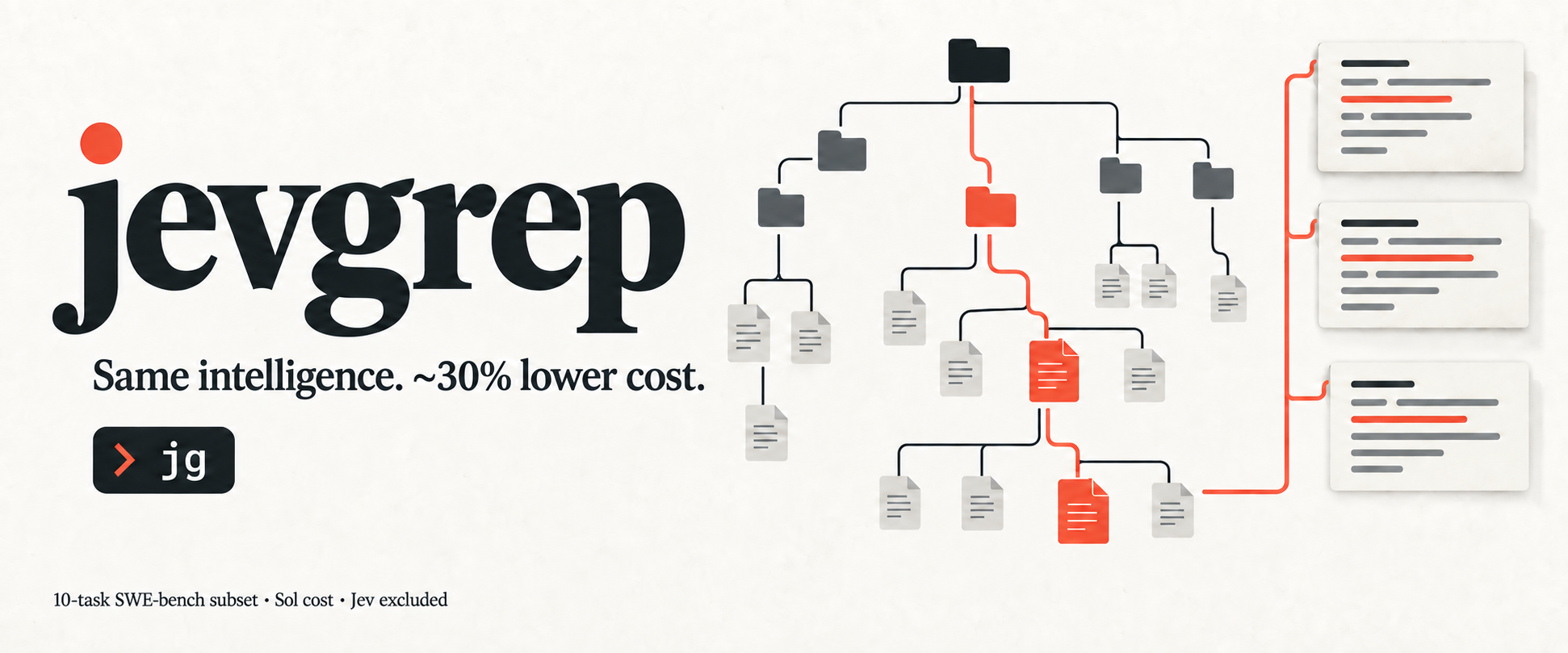
Coding agents waste a lot of tokens just finding their way around. They grep, open a file, open three more, and slowly work out where the logic actually lives. jevgrep (jg) is a CLI built for that step. You ask it a plain question about what the code does. It sends back the relevant files, leads on what to read, and source excerpts quoted exactly. Your agent reads evidence instead of crawling the tree itself.
How it works
jevgrep uses Jev to judge what's relevant at three levels: folders, files, then declarations inside files. It parses declarations for Python, TypeScript/JavaScript, Go and Rust. Other text goes through a fallback. The output has three parts. First a summary and file list, then excerpts with line references, then where things are declared and called. It deliberately doesn't write an answer. It hands evidence to the agent and lets the agent reason.
jg skill installs a skill that teaches Claude Code, Codex, OpenCode and others when to call it. Before a search, jg files [root] shows which files would be read, with no network call. Default filters respect ignore files and skip hidden, dependency, build, binary and obvious credential files.
Try it
npm install -g @dzhng/jevgrep
jg auth
jg skill
jg "How are telemetry events recorded and sent?" ./my-project
You need Node 22+ and a key for Vercel AI Gateway, TypeSafe, OpenRouter, OpenCode Zen or a compatible endpoint. Run jg doctor if something looks off.
My take
I like that the README is honest about its numbers. On a 10-task SWE-bench subset, the agent solved the same 8 tasks with and without jevgrep. Agent cost dropped about 28.6% before counting Jev's own cost. A later rerun that included Jev showed 25.8% lower total cost. It's a single run, and the README says outright that this doesn't prove equivalence or a speedup on every repo. That kind of caveat makes me trust the rest more.
The design is right too. It returns verbatim source rather than a summary, so the agent can't be misled by a confident paraphrase.
There are real limits. Eligible source gets sent to whatever provider you pick, and the filters don't guarantee secrets stay out. Check your search roots before pointing it at a client repo. It also doesn't promise to find every relevant file. And if you already know the symbol or path, rg is enough.
Who should care: anyone running agents on large or unfamiliar codebases, where most of the bill is exploration. It's MIT licensed and cheap to try on one repo to see if your costs move.